Drawn Once, Lit Five Ways
The pictures at the top of this site's pages are not photographs, and no image generator drew them. Each is drawn in code when a page loads, on screens wide enough to show it. An artificial intelligence (AI) assistant wrote that code. I decided what each picture shows, and checked every real place in them against photographs. The stars in them are real stars, at their true positions over Antigua on one evening in May, and the Moon is tonight's Moon, in its real phase, drawn only if it is really up.
They began during the September redesign, which has its own write-up, and grew into a small world of their own: one subject on each page, drawn from photographs, then redrawn for every time of day. This is how they were made, and how much of what they show had to be checked before it could be claimed.
Scenery Drawn in Code
The night sky is real. The stars are the whole Yale Bright Star Catalogue at their true positions over Antigua for a particular evening, 3,542 of them above the horizon at night, with 9,033 fainter ones from the European Space Agency's Hipparcos catalog and the true path of the Milky Way. The Moon, Venus and Jupiter appear only when they are actually up over Antigua, the Moon in its real phase for the visitor's date, and the islands on the horizon of the home page are traced from satellite elevation data at their true bearings. Where the art takes a liberty, the code says so: the islands are drawn 2.6 times their true height, the Moon several times its true size and set where each picture composes it (over Shirley Heights, moved down into a sky too short to hold it), and a thin fill of painted stars is labeled as the one part of the sky that is not real.
Each page's picture is one subject, drawn from photographs, several of them my own. Shirley Heights, the view over English Harbour on the For Students page, went through three versions in about 45 minutes. The first was close but off, and it is a view people recognize worldwide, so it had to be identifiable at a glance. The second traced the landforms from a photograph, recording each point as a fraction of the picture's width. The third used my own photographs, turned the sky to the true bearing of the view so that the May sunset sits behind the far range as it does from the lookout, and left out the cacti, which do not read as cacti once stylized.
The corrections came from looking. The first piece, a lecture hall, appeared to hang over the water. The grain added to make the pictures look printed read as noise on the land. When I said the home page's sky looked sparse, the stars per million pixels were measured instead of guessed (1,030 on the home page against about 9,500 in the smaller pictures), which pointed to scale rather than the star catalog as the cause. And when five placements were drawn one night while I slept, I approved two and declined three, because a picture should be about the page it sits on. The declined drawings were kept, and one of them, St John's Harbour, is now on the About page.
The method that reached a standard I was happy with is written down in the site's design reference, along with a script that renders a piece at two screen sizes and in each of its five versions, beside the page it belongs to and the photographs it was drawn from. The rule it encodes is simple: nobody sees a first draft.
The Same Place at Five Times of Day
After the redesign went live, a colleague who prefers light mode asked on a call why the site looks so dark. The answer was the toggle, but the question stayed with me: every picture was drawn at dusk or at night, so even a light page opened onto a dark window.
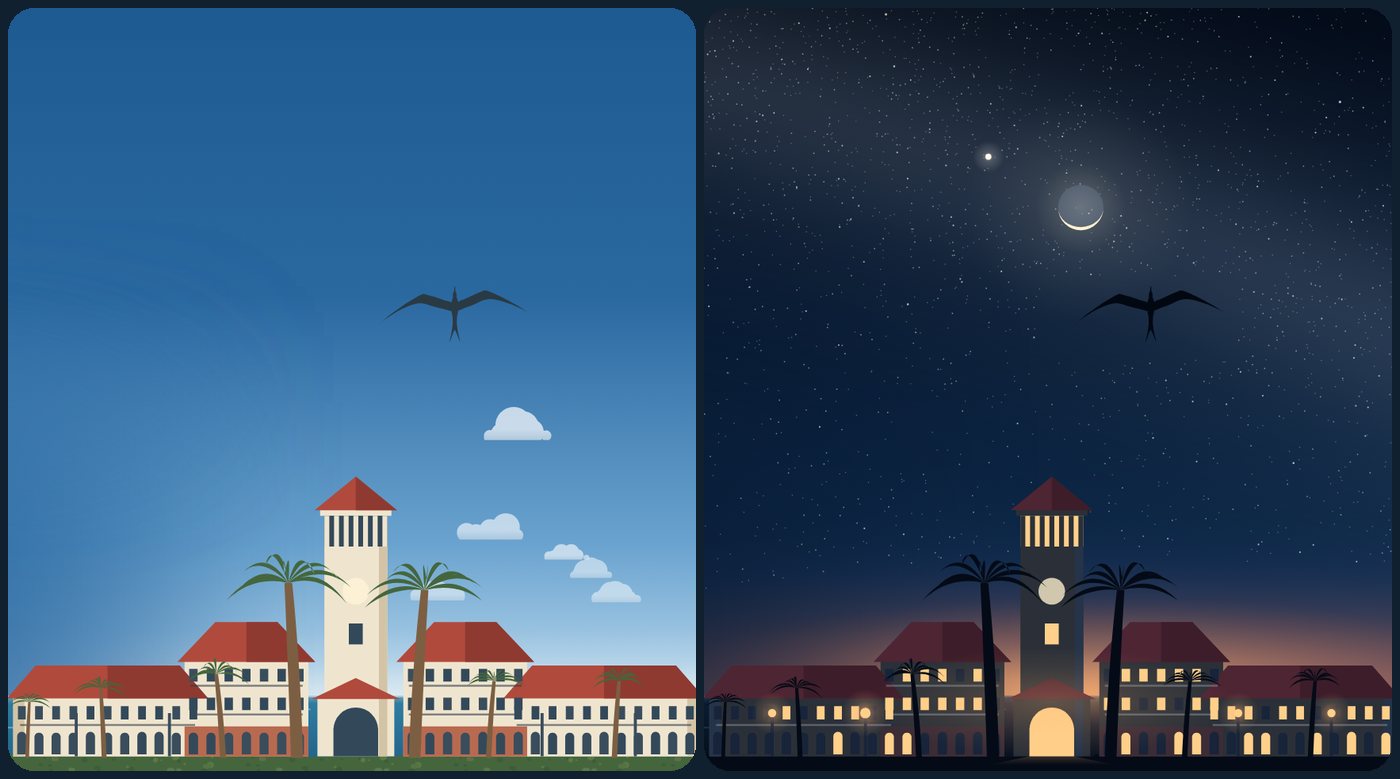
So every picture now comes in five versions, Dawn, Day, Sunset, Dusk and Night, and the visitor's own clock chooses among them: Dawn from 5 in the morning, Day from 9, Sunset from 5 in the afternoon, Dusk from 7 and Night from 9. The light and dark toggle now changes only the page, not the picture. A page left open follows the clock too, crossfading to the next version when the hour turns.
The clock on the American University of Antigua's tower keeps Antigua's time, Atlantic Standard Time, wherever you are reading from, while the sky follows your own clock. For a reader in Antigua the two agree; for anyone elsewhere, the tower shows what time it is on campus.
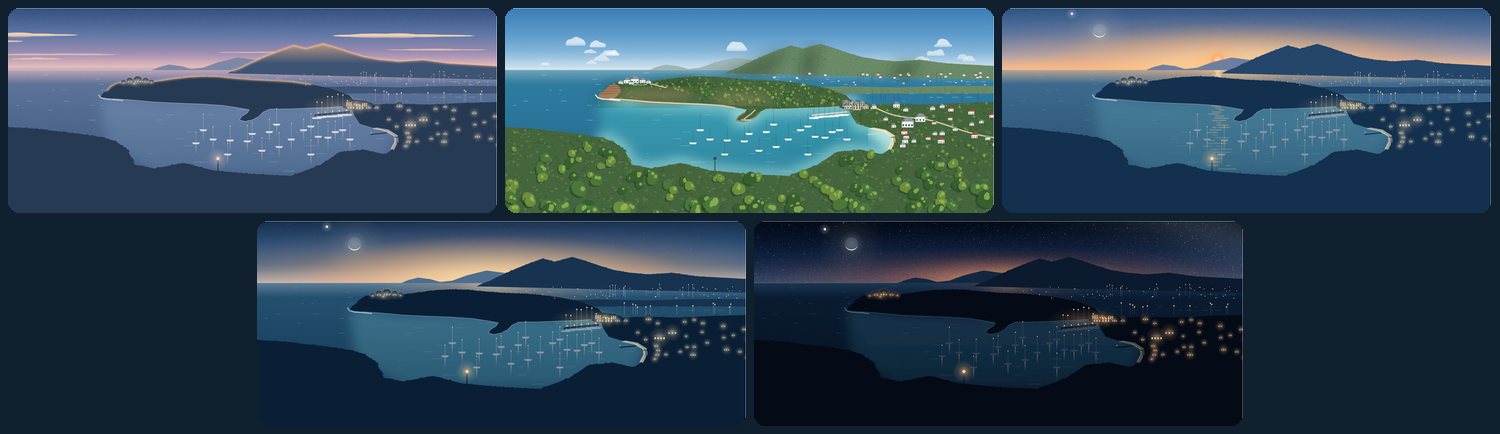
Each picture is drawn once, and the light is what changes. A version is a set of colors for the sky, sea, land, stone and roofs, shared by every picture, plus a few rules: the lights are on except by day, stars and grain belong to dusk and night, and the Moon appears only from sunset on, in its real phase and only when it is really up. Daylight, though, shows what the dark had hidden, so Day needed new drawing. Shirley Heights was the test piece, drawn from my own photographs of the view: the house compound on its knob above the bluff, Nelson's Dockyard on its land bridge with its dock and moored yachts, and Galleon Beach with its sand, its pier and the palms behind it. Buildings are drawn in every version, so a lit window at night is a house by day.
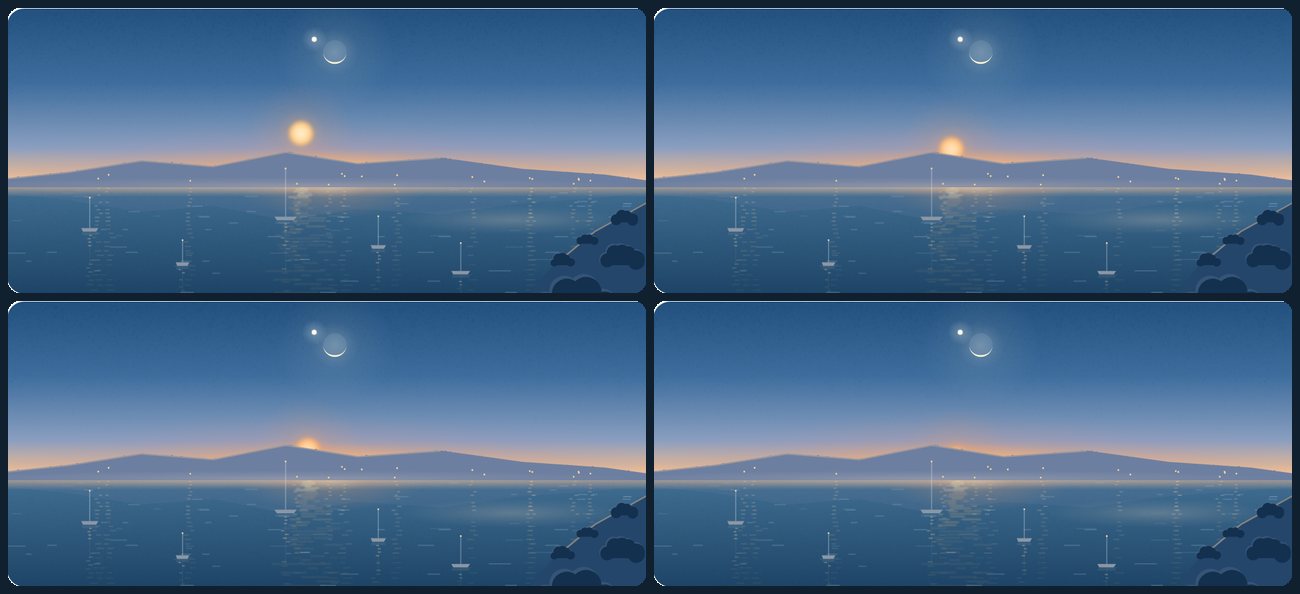
The Sun follows the same rule as the stars. It appears only where it truly is, taken from the same ephemeris (the table of true positions) for the same date. At dawn it rises behind every view but one. By day it is high overhead, out of every picture, so Day has none. At sunset it is in view in most pictures, but a single moment would hide it behind land in some and leave it floating in open sky in others. So each picture takes its own true minute of the sunset hour, chosen from a sheet showing it at eight minutes between 5:40 and 6:31 in the evening. In the view drawn for the Learn page it rests on the summit of the far hills; on News & Events it touches the sea between the yachts. Where land stands in front of the Sun, it lays no path of light on the water, because what hides it from the viewer hides it from the water in front too.
The finish came from somewhere else. My other project, the media tracker behind My Favorite Game Was Not a Game, draws its own night scenes with a small toolkit, and those scenes set the standard. Some of its code was ported nearly line for line: ripples on the water, dense at the horizon and long near the viewer; broken columns of light under lamps and the Sun; the print grain; and a seeded random sequence, so that a picture draws the same way every time. Other techniques came over as ideas: mirrored reflections, halos and pools of lamplight, mist, motion limited to what a browser can animate smoothly (and switched off for anyone who asks their device for less motion), and one shared world with a single subject on each page. Some things stayed behind. The tracker's indigo palette is lovely, but I kept the navy and teal here because they sit closer to the school's own colors. Its grain covers everything; here it stays on the sky and water, because on the land it read as noise. Its scenes move continuously, while these play one gentle pass and then hold still. And the tracker draws no daylight at all. The influence ran both ways: the tracker's own island scene began as a port of this site's first art study.
The tools were the ones used for the redesign's layout work. A headless browser rendered every version of every picture at several screen widths in both color schemes. The white headline on the home page was measured against the picture behind it, with the words hidden, and kept a contrast of at least 4.5 to 1 in every version. A test with a faked clock carried each page across all five boundaries to check that the pictures turned. Before the work was merged, two reviewer agents read the changes without editing anything and found eight small defects, among them lanterns that lost their glass by day and boats that kept their navigation lights on.
The rest came from looking again. Across that day I caught a tree standing in the water, black lines drawn through the beach, a reflection under a Sun already set behind the land, a wisp of haze that read as a stray cloud, green palm trunks, a green iron fence, and the school hanging off the edge of its lawn. The first Sun was also a crisp, bright disc that sat oddly against the softly shaded land, and a different size in every picture. It is now soft, deeper and redder near the horizon, and the same size everywhere.
Captions, a Library and Tonight's Sky
The next day I looked at the pictures in place and asked for smaller things. Every picture now starts level with its page's title, or with the breadcrumb on a deeper page, where the breadcrumb is the top line. A picture of a real place also has a caption: what it shows, then the time of day it is drawn at, which links to this write-up and says "About the pictures" when you hover over it. The picture gives up exactly the height of its caption, so nothing else on the page moves. A caption is a claim in a way a drawing is not, so two AI agents checked each one against published sources, the second trying to prove the first wrong. They caught three errors in my drafts: Shirley Heights looks northwest over the two harbors, not west; Montserrat lies southwest of Curtain Bluff, not west; and the old courthouse is dated 1747 by some sources and 1750 by others, so its caption gives no date. A picture of no particular place, like the guides' lamp-lit steps, has no caption at all, since one would only describe what is already evident.
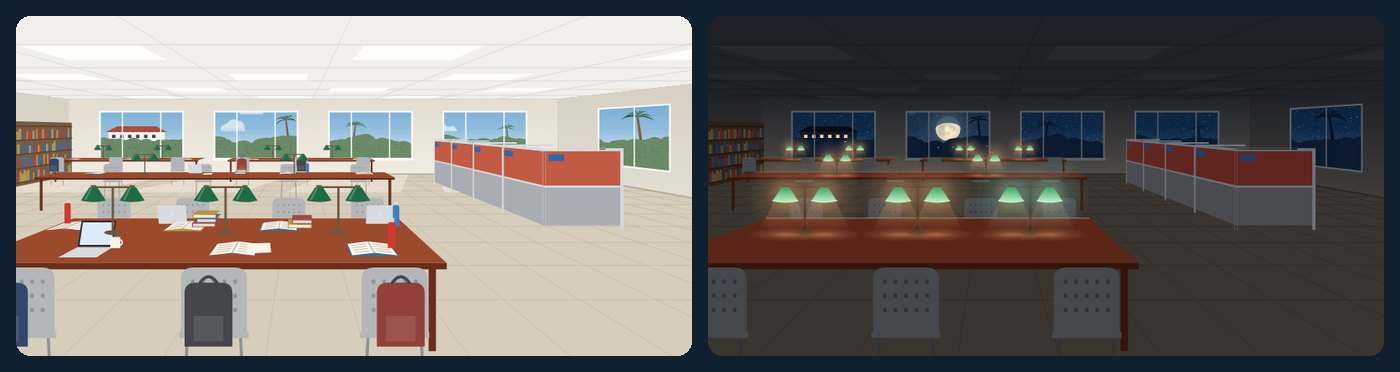
The Learn page's picture became the American University of Antigua's own library, drawn from the school's photographs of its study hall with the people left out: the double green banker's lamps on long cherry tables, gray chairs and the red study carrels. It is the only interior, so its windows carry the time of day and its lamps are the lights. What is on the tables follows the clock too: textbooks, laptops and backpacks by day, a few early arrivals at dawn, fewer as the sun sets, only the library's own stacked books at dusk, and at night nothing but the lamps. When the page grows taller to show where a reader left off, the picture shows more of the same hall rather than a bigger room.
The last thing that was not true was the sky. Every night picture showed the same crescent Moon from that one evening in May, and one shape repeated across eight pages starts to look like a symbol. The Moon now shows its real phase for the visitor's date and appears only when it is actually up over Antigua at that hour, so on a moonless night there is none; Venus and Jupiter follow the same rule. Each still sits where its picture places it, with the Moon's lit side toward that picture's sunset, and the Moon now shows its darker seas, faintly. The positions come from published astronomical formulas, the same ones used for the rest of the sky, and are worked out in the visitor's browser, with nothing to download or update. Before trusting that code, I had it checked against the separate program that computed the rest of the sky, at 400 moments over four years: the two agreed to within a hundredth of a degree, and every time on whether each body was in the sky. Sunset was also made redder and dawn more purple, so the two are not mistaken for each other; dusk became darker, closer to the real sky at that hour, with only a faint glow left on the horizon; and night has no glow at all.
What It Cost
The pictures were first drawn during the redesign, and that work is counted in its write-up. The five times of day came later, on September 28: 20 commits over about seven and a half hours, adding 802 lines and removing 100 across seven files.
The captions, the library and tonight's sky followed on September 29: ten commits over about five and a half hours, adding about 940 lines and removing about 75 across 13 files.
What Transfers
- For a real place, trace it from a photograph. Memory draws a generic hill.
- Draw a scene once and make the light the variable. Five times of day cost a set of colors each, not five drawings.
- Where accuracy matters, choose among true moments rather than inventing one. The Sun sits where the ephemeris puts it, at the minute that composes best.
- Test anything that depends on the time of day with a faked clock, and measure contrast on the rendered picture, not on the colors you meant to use.
- A caption is a claim. Check each one against a published source, with a second reader trying to prove the first wrong.
- If a picture shows a real sky, compute it for the reader's date rather than freezing one evening, and test the calculation against an independent one before trusting it.
What This Does Not Show
The stars are one evening in May: the pictures follow the hour of the visitor's day and the real Moon and planets, but not the season, so the stars stay as they were that evening. And the art, however carefully sourced its stars, is a matter of taste: mine.
Content last reviewed October 29, 2026. Review dates are maintained as described on the About page.